
Hammerfest, Norway, January 2015
A flashback from a trip done previously
Hammerfest is a small town in the North of Norway, until recently the most northern town of the world. The town is on the coast, by a fjord, surrounded by mountains. In summer it's said to be lively, but in the middle of winter it slumbers cosily. We spent a couple of weeks in Hammerfest January 2015. We being a contemporary dance group and me being its lighting designer, planning a new performance in the residency of Dansearena Nord.
My original plan for January was to go to Thailand hammocking, but one should be careful for what one wishes for, since one might get the very opposite.
It's not simple to get to Hammerfest, especially in winter: Our route proceeded from Helsinki to Copenhagen, from Copenhagen to Oslo, from Oslo to Tromsø and from Tromsø to Hammerfest, planes getting smaller and clientele less posh every leg.
It was a good trip, though. We got some work done, met some nice people, took turns in having a stomach flu and I even had some time to see the sights. If you really curb your speed, you might end up using one whole afternoon to see them. My list of recommendations is as follows, but most of all I loved the hues of blue, colouring the scenery all julianonderdonk.
Hammerfest Church
Burning churches was a fad in Norway some time ago, so architect Harald Magnus was clever in advance in choosing concrete as the main material for the church, completed in 1961. There are triangles everywhere in the construction, also in the colourful glass painting by Jardar Lunde. Oh my Gordiskknute, that's one confusing altarpiece! I'm not quite sure if Christ is dying, ascending or being captured by aliens. Anyhow, it's a groovy piece of art

Museum of Reconstruction
Gjenreisningsmuseet tells a sordid story of Hammerfest during and after World War II. Shortly put: before the war Hammerfest existed, after the war it did not. As the German army retrieved, it was scorched-earth policy all the way. There were two options for people in demolished Hammerfest, to be forcibly evacuated to southern cities or to hide in the woods and caves, waiting for the Allied Forces to arrive – which took way longer than expected. Quite an experience, even after seventy years. Luckily, there's a museum cafe with ultimate comfort food: warm waffles. You'll need them.
The Ultimate Blueness
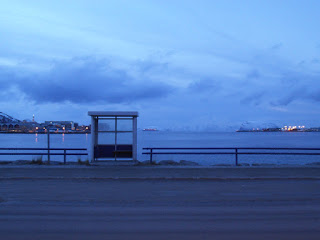
At the time of our visit, sun didn't rise above the horizon at all. Still, there was some daylight, like for fifteen minutes per day. After that it started getting blue. And bluer. And then, even bluer. Then, it got Klein International Blue. Then, Klein International Bluer. Just when I thought it possibly couldn't get bluer than THIS, it got bluer. And then some. And then, it was dark. You could suggest that this blueness happens elsewhere, too, but hello, I'm a tourist and experienced it here so I won't listen.



The Arctic Culture Center
Check their website, the Center might have something of your interest in the program: concerts, plays, dance, movies, you name it, mostly during evenings. The building is worth seeing in its own right, too, with a scenic window facing the bay, and a café, should it be open. The building is somewhat a landmark of the town, lighted blue during the dark.
Nissen Mall
A small shopping mall slightly resembling an offshore oil rig, Nissen includes an almost hipster café and a shoe store called Eurosko. Among the usual shoes, you can find some pretty cool traditional and traditional-ish shoes here.


Pieces of information
• More about traveling in Hammerfest area in the Northern Norway webpage, including Hammerfest Church and Gjenreisningsmuseet
• Other people exploring Hammerfest: Vagabond Baker
• Fresh after the trip, I wrote about it to Kummat kengät blog from shoe perspective, in Finnish.
• Arctic Culture Center's website, in Norwegian
Hammerfest is a small town in the North of Norway, until recently the most northern town of the world. The town is on the coast, by a fjord, surrounded by mountains. In summer it's said to be lively, but in the middle of winter it slumbers cosily. We spent a couple of weeks in Hammerfest January 2015. We being a contemporary dance group and me being its lighting designer, planning a new performance in the residency of Dansearena Nord.
 |
| Welcome to Hammerfest! |
My original plan for January was to go to Thailand hammocking, but one should be careful for what one wishes for, since one might get the very opposite.
It's not simple to get to Hammerfest, especially in winter: Our route proceeded from Helsinki to Copenhagen, from Copenhagen to Oslo, from Oslo to Tromsø and from Tromsø to Hammerfest, planes getting smaller and clientele less posh every leg.
 |
| This is not Thailand |
It was a good trip, though. We got some work done, met some nice people, took turns in having a stomach flu and I even had some time to see the sights. If you really curb your speed, you might end up using one whole afternoon to see them. My list of recommendations is as follows, but most of all I loved the hues of blue, colouring the scenery all julianonderdonk.
 |
| I have no idea what this is |
Hammerfest Church
Burning churches was a fad in Norway some time ago, so architect Harald Magnus was clever in advance in choosing concrete as the main material for the church, completed in 1961. There are triangles everywhere in the construction, also in the colourful glass painting by Jardar Lunde. Oh my Gordiskknute, that's one confusing altarpiece! I'm not quite sure if Christ is dying, ascending or being captured by aliens. Anyhow, it's a groovy piece of art

Museum of Reconstruction
Gjenreisningsmuseet tells a sordid story of Hammerfest during and after World War II. Shortly put: before the war Hammerfest existed, after the war it did not. As the German army retrieved, it was scorched-earth policy all the way. There were two options for people in demolished Hammerfest, to be forcibly evacuated to southern cities or to hide in the woods and caves, waiting for the Allied Forces to arrive – which took way longer than expected. Quite an experience, even after seventy years. Luckily, there's a museum cafe with ultimate comfort food: warm waffles. You'll need them.
 |
| There wasn't a sudden summer day in January, the photo is from Wikimedia Commons, by Manxruler, since I failed to take one |
The Ultimate Blueness
At the time of our visit, sun didn't rise above the horizon at all. Still, there was some daylight, like for fifteen minutes per day. After that it started getting blue. And bluer. And then, even bluer. Then, it got Klein International Blue. Then, Klein International Bluer. Just when I thought it possibly couldn't get bluer than THIS, it got bluer. And then some. And then, it was dark. You could suggest that this blueness happens elsewhere, too, but hello, I'm a tourist and experienced it here so I won't listen.


 |
| It did get even bluer, but my camera refused to believe. |
 |
| The scenery might have affected the lighting design of the piece we were working on |
Check their website, the Center might have something of your interest in the program: concerts, plays, dance, movies, you name it, mostly during evenings. The building is worth seeing in its own right, too, with a scenic window facing the bay, and a café, should it be open. The building is somewhat a landmark of the town, lighted blue during the dark.
 |
| Arctic Culture Centre, this is where we worked |
A small shopping mall slightly resembling an offshore oil rig, Nissen includes an almost hipster café and a shoe store called Eurosko. Among the usual shoes, you can find some pretty cool traditional and traditional-ish shoes here.


Pieces of information
• More about traveling in Hammerfest area in the Northern Norway webpage, including Hammerfest Church and Gjenreisningsmuseet
• Other people exploring Hammerfest: Vagabond Baker
• Fresh after the trip, I wrote about it to Kummat kengät blog from shoe perspective, in Finnish.
• Arctic Culture Center's website, in Norwegian


